The casserole issue

There’s a phenomenon you’ll see, if you drive through certain towns or parts of suburbia in England. I saw it from a bus last Saturday, on my way to a hike in Buckinghamshire. You’re going down a road and suddenly every pole down the center of the street has an English flag (the red cross of St. George) or a UK flag. The flags are usually alternating, and at half-mast.
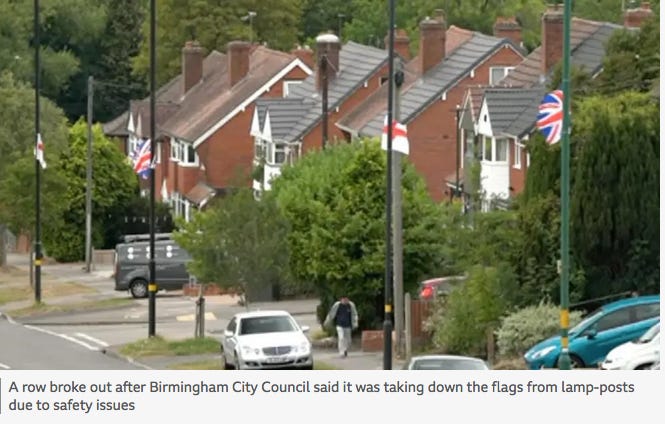
The BBC reported it’s called Operation Raise the Colours.
This would not be remarkable if there were an international sports competition going on, but the rest of the time, all these flags are extraordinary. This country is not like Canada or the U.S., where it’s normal to see the national flag flying everywhere, from someone’s yard to a car dealership. These flags, the news tells us, are to “send a message.” They are put up unofficially, and so, as they’re not supposed to be there, some town councils have come and taken them down. Then, overnight, the flags go up again.
As I say, if you’re from North America you might not see why anyone would take down the flag of the country we are in. But for as long as I’ve known this country, it’s had a complicated relationship with the flag. For one thing, there’s the whole England as part of the UK thing. There are different countries here (Scotland, Wales) and when you see those flags flying, it means something political: Welsh pride, or a vote for Scottish independence.
Or again, it might just be a football or rugby competition.
Flying either the English or the UK flag, outside of the sports context, seems embarrassing to some, aggressive to others. The story of the flags that keep going up and down in certain communities is a story about immigration, and all the people from other countries, with other languages, who have moved into those communities. The flags are supposed to remind them that they’re in England now. The people flying the flags say they are proud of their country and they want everyone who lives here to be proud to be British too.
People to the left of them, and some officials, perceive the message as anti-migrant, or even racist. The flags are unofficial. They must be taken down.
I don’t know whether they’re at half-staff to send some kind of message about mourning. More likely, that’s just as high as amateurs can reach.
There’s a history of the flag here that I don’t really understand. When far-right British nationalists have flown a flag, it’s been their own flag. That makes things complicated. After all, it’s easy to identify a Nazi if they’re flying a swastika. The U.S. has its history with the Confederate flag. But what do you do if someone takes your flag—the same one you fly at football games and the Olympics—and their message is something that you do not support? Do they really get to take that flag away from you?
When I was growing up in the U.S.A., it was the centennial of the Statue of Liberty in New York Harbor. The statue had been a gift from France, and I remember the French president joining Ronald Reagan for a celebration. Reagan spoke about America being a nation of immigrants, in a way that conveyed pride. That same year, Reagan’s America also found a way for “illegal aliens,” as they were called, to become legitimate members of U.S. society. It was forty years ago.
I’ve written a lot about my own experiences as an immigrant, from one privileged country to another. So that’s not what this post is about. What I’m thinking about is something I heard from a Baptist minister and researcher named Ryan Burge. Ryan writes about religion in America, how people are more (or less) religious, and the role religion plays in their lives. He was a pastor until recently, and argues that everyone needs this type of neighborly support in their lives that church provides—even though everyone is not religious or a churchgoer:
“I call it the casserole problem. Like if you go to the hospital and you get discharged, you go home and you can’t cook, who’s going to cook for you? Well, when both my kids were born, I came home and there was a pot of soup on my step, both times, from ladies from the church. That’s what makes life worth living, that sense of community and belonging and togetherness. We haven’t replaced that with anything.”
Here in England, I spent Sunday with an interfaith group in a London park celebrating the Jewish New Year of Trees (Tu B’Shevat). One of my friends, a student rabbi, organized it with her synagogue. The local Member of Parliament came to help plant a tree. She spoke about how multiracial and interfaith gatherings like this were part of the “front line” against racism and the far right. Given everything that’s going on in the world, it felt like a radical day of action.
But it was so low-key and peaceful; people singing songs with children, planting a tree, talking about what nature meant to them. Other than the MP’s words, there were no other overtly “political” moments in the day. For a while, we were joined by three police officers; it’s a sobering fact that Jewish gatherings and events organized by Jews are always in the shadow of anti-Semitic threats. At least one of the policemen was singing along with a tree song.
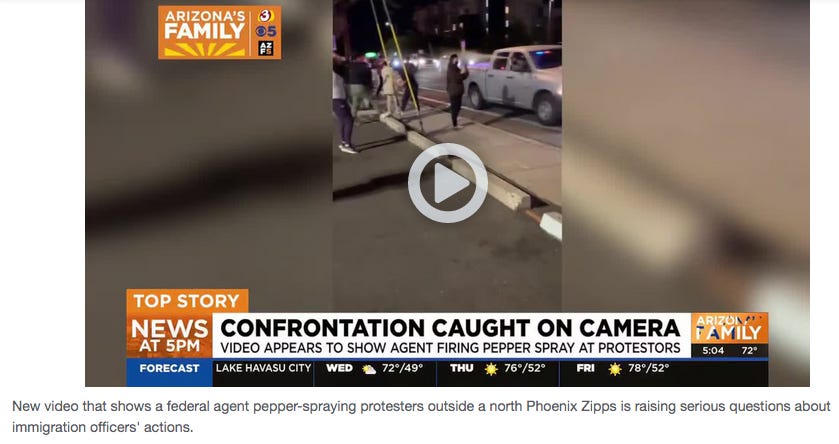
Back in America, neighborhoods have put together networks to keep an eye out for members of their community who feel under threat. Another sobering fact is that groups of masked, heavily armed agents are on the streets of U.S. cities—paramilitaries, a far cry from the local police who joined our Tu B’Shevat. They are supposed to be deporting illegal immigrants, the “aliens” Ronald Reagan granted amnesty to. But, as we’ve all seen even from abroad, their reach has far exceeded that mandate.
The neighborhood networks I’m talking about let each other know when the agents are coming and their neighbors are too scared to go out. Not because they’re criminals, but because of their color, or because they don’t want to get grabbed and have to prove they’re U.S. citizens—even when they are.
As long ago as October, a pastor was snatched by Immigration and Customs Enforcement (ICE), and many Latino Americans have been staying home from church. During Advent, some bishops took the extraordinary step of issuing a dispensation for Catholics from attending Mass, for fear of immigration enforcement actions. There are Catholics in America who so strongly oppose abortion that they have voted based on that one issue—as, indeed, did many other Americans. Then they saw their co-religionists afraid to go to church, at the holiest time of year, because church is not a sanctuary for them.
In Letters from an American on January 25, Heather Cox Richardson wrote: “Reports out of Minnesota say that in the face of the terror inflicted on it by federal agents, the people there are even more closely linked together in community solidarity. They are patrolling the streets, donating food, delivering groceries, helping with legal services, organizing to look out for each other in a demonstration of community solidarity so foreign to administration figures that Attorney General Pam Bondi yesterday suggested that there was something nefarious about how well organized they are as they protect their neighbors.”
It is not nefarious. It resembles the way people on our road, here in Twickenham, looked out for each other during the COVID-19 pandemic and have continued to do so. I’m proud of my family and friends for sticking up for “the least of these” when, quite frankly, it is scary how close the threat is to their homes, schools, and places T. and I love in the States. The scenes of heavily armed agents on American streets are as alien to us as, apparently, the concept of neighborhood organization is to Attorney General Bondi.
It’s the casserole issue. If you aren’t part of a church—or if you’re too afraid to go to church—who is going to bring you that casserole?
Sometimes, loving one’s neighbor isn’t to do with any place of worship. It’s delivering a meal, or being outside planting a tree.