
Gloria and Goliath
For those who read the Bible or want to

As I write this afternoon, it is Christ the King Sunday, the last Sunday of the church year. The church calendar ends with this celebration of the Reign of Christ, which means that next Sunday begins Advent, the start of the new church year. For this reason, I am resuming my occasional series on reading the Bible. Many people make this habit a New Year’s resolution, but I’m tying it to the new church year, because I have recently found a great resource on this from Gloria Wall. (I found it via her son, Aron Wall, a theoretical physicist at Cambridge who is also a Christian believer and blogs on such topics at “Undivided Looking.”)
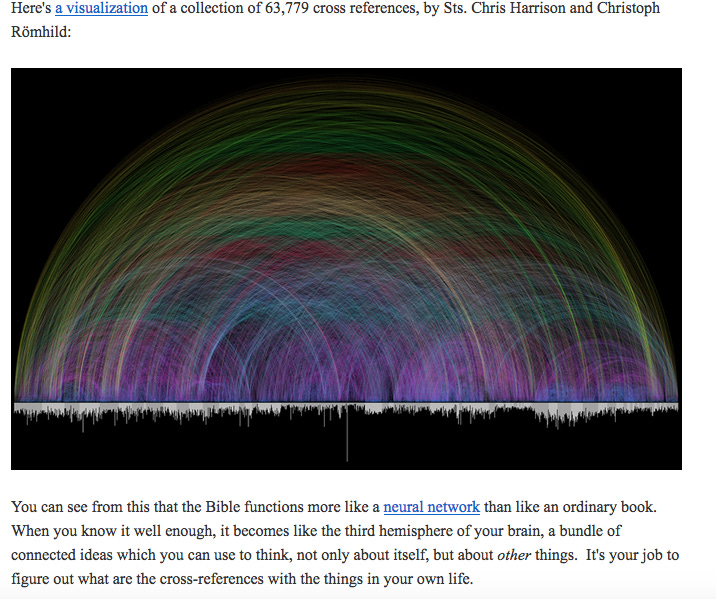
Gloria Wall’s plan may be found here: http://www.wall.org/~gloria/lect/index.html
This plan follows the Revised Common Lectionary. The lectionary is a 3-year cycle of readings that are common to many churches and are therefore read aloud, as part of the service, on Sundays. Gloria, the Sunday school teacher who put this plan together, has filled out the readings and other parts of the Bible that are not in the lectionary, so by the end of 3 years, you’ll have read the entire Bible, including some parts more than once. I was delighted to find Gloria’s plan because I’ve long found following the lectionary useful, but like her, wanted a way to integrate it with reading through the entire Bible. As it happens, Year A of the lectionary (the first year of the 3-year cycle) starts next week, on the first Sunday of Advent! Which is why I’m sharing this plan now.
The benefit of Gloria’s plan, besides it being a fairly forgiving schedule in terms of quantity, is that it’s linked to the seasons of the church year (like Christmas and Easter). You’re following along with services at your own church, if it uses the common lectionary, or at least with many other Christians in different countries who are all reading the same passages of the Bible. Gloria’s FAQs page explains options for just reading and meditating on the next Sunday’s readings during the week, or adding the rest of the chapter(s) in parentheses.
I don’t think this plan would be great for someone not already familiar with the story of the Bible, because it takes so long to go through a single book. But it does have another advantage, in that you can start any week of the year. I also think it would be great for people who want to read the Bible together each week, such as a church or Bible study group.

The way I use the lectionary is to keep up with my study of biblical Hebrew. I’ve avoided forgetting everything I learned about the Old Testament languages by taking time, usually each week, to look at a passage in the original. The lectionary passages, their length selected for public reading, are manageable chunks of the Old Testament books (including Psalms) to tackle. Since completing my diploma in the 1990s I’ve read once through the entire Hebrew Bible; if I follow all the chapters Gloria has included, week by week, I may get through it again, depending how long the Lord lets me live!
Gloria’s links to the Scriptures automatically open the New International Version, which is the translation she uses. Should you find reading the Bible passages online useful, you can click to read another translation. With respect, the rest of this post is my response to the NIV, which I started reading for the first time while my old Bible was “in the shop.”
One of the familiar objections to the Bible is that “it’s full of contradictions.” But the Bible is unapologetic about its different strands of tradition; they are right there, from the very beginning of the first book. Read the first two chapters of Genesis and you’ll immediately see that they’re two stories of the creation of the world, back to back. One could dig into the manuscripts and the different traditions they come from, but from a reader’s point of view, these are two stories reinforcing the same theme. The author of Genesis wanted us to know that we have a Creator, who cares about us, and emphasized this by telling us twice.
Whether one thinks of the author as the ancient scribes who first compiled the manuscripts of the Bible, or God Himself, this is the book of books that we have. And there are two ways to read such a “contradiction,” right out of the gate. One is to see that both these stories convey the same idea and because they are back to back, that idea is being reinforced. The differences between the stories are not obscured at all. I conclude from this that the details of how God created the world are not the point—there are different versions of those, right there in Genesis!

The other way is to worry about the contradictions in the Bible, to try to harmonize them so they don’t seem like different traditions in the same story, and smooth over inconsistent details. This appears to be the approach that the translators of the New International Version have used since that version of the Bible first appeared in 1978. I knew the NIV was a “dynamic equivalency” type of translation, forgoing the more literal (word for word) formality that is a hallmark of older English Bibles, like the King James and Revised Standard Versions. From a literary point of view I’m not a fan of that, but I’ve been reading the NIV on its own terms: as a dynamic translation aiming to bring readers the meaning of the Bible in clear modern English.
I am not the only person to find, with disappointment, that it’s failed.
Paul Davidson has compiled hundreds of examples, but I give just two below. The first is one I discovered myself while reading Genesis, merely because I’m familiar with Genesis and have read it many times before. The other is from a story so often depicted in art that even people totally unfamiliar with the Bible have heard of it: David and Goliath.
(1) Genesis 34 contains a subplot of the story of Jacob’s sons. In this story, Dinah, Jacob’s daughter, is sexually assaulted by a man from another nation. Dinah’s brothers take revenge on these uncircumcised people. In the NIV, verse 17 has them saying deceitfully to those who victimized Dinah, “[I]f you will not agree to be circumcised, we’ll take our sister and go.”
Only the Hebrew doesn’t say “sister.” It says “daughter,” which is how other English versions such as the RSV translate it. The NIV translators, while acknowledging daughter in a footnote, appear to have used sister because the speakers in this passage are Jacob’s sons, and (as is evident in the following paragraph) Jacob isn’t party to what they’re saying or doing.
But this kind of editing is not what a translator is supposed to be doing. No version of the Hebrew text, that I am aware of, has sister here. Moreover, readers who are familiar with the Bible, and the form its language often takes, will be able to imagine how daughter is being used. Rather than a mistake that needs correcting, “daughter” may mean “daughter of my people”; that is, not literally the daughter of the speaker, but an expression similar to “our women” (remember, these guys are patriarchs!) Readers of a more formal translation—“Bible-ish” language—are at an advantage here. The aim of the NIV, and it is an admirable one, is to make the Bible readily understandable to a modern audience. But how is that audience served by words that aren’t in the original?(2) In II Samuel 21:19, the Hebrew tells us that Elhanan killed Goliath the Gittite. Here is an immediate contradiction of the well-known story that Goliath of Gath was killed by David, someone far more famous than Elhanan. Unlike most other Bible translations, the NIV can’t handle two versions of this story and so it states that Elhanan “killed the brother of Goliath the Gittite.” There is no mention of a brother in any tradition of the text. The NIV translators appear to have added these words for reasons of their own.
It may be argued that neither these mistranslations, nor many others, make much of a difference doctrinally. However, the fundamental problem is that the NIV translation approach is to the Bible as the inerrant Word. The translators believe that everything in the Bible is included by God. Even the genealogies listed in some of the earlier Old Testament books appear to be “harmonized” by the NIV translators with those in Chronicles. No one would care about variations between the text of these books if they thought the genealogies were unimportant, or didn’t expect anyone to read Chronicles.
But if it’s all important—the Word of God--then it is crucial to present the Word to readers faithful to the original meaning, if not in form. A “dynamic equivalency” translation such as the NIV has as its aim that readers should understand the Scriptures in their own (English) language. Its aim is different from that of someone, like me, who wants the form of the original languages and the tradition of their literary style in English. I can forgive the dynamic approach for sacrificing literary style, but if the equivalency part is missing—if sentences, hundreds of sentences, in the NIV don’t mean what they mean in the original—then it’s failed in its aim. A Bible translation can be great literature, but what it must be is a translation of the Bible!

So. Given that the NIV fails, in my view, to be either the Bible as literature or an accurate translation, do I think it is without uses and should be “commended to the flames”?
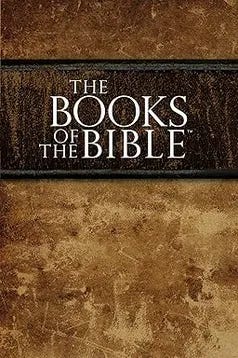
Surprisingly, no. I’m really enjoying the readability of The Books of the Bible, the NIV edition without chapter and verse divisions. I look forward to sitting down and reading pages of it, like a book, every time. I also think the NIV is fine for someone new to the Bible—or, conversely, if you already have an NIV and it’s “your Bible,” one you’ve read, marked, and are familiar with.

What I recommend is that the NIV needs a chaperone. It should never be left alone with a reader, in the absence of any more accurate translation. Read it, but compare it with a more formal translation: the Revised Standard Version, the New Revised Standard Version (there are others but these are the ones I am familiar with).
Funnily enough, this is the same approach recommended by the authors of How to Read the Bible for All Its Worth—even though they are partial to the NIV. If you can’t read the original biblical languages (Hebrew or Greek), then the next best thing is to have more than one translation approach to compare.
For reading the Bible is not about an end goal; it’s about a regular process. If Gloria’s lectionary plan isn’t for you, fear not. I will post some other ideas before the end of the year.

Excellent discussion of how to read the Bible and of the NIV in particular: "if sentences, hundreds of sentences, in the NIV don't mean what they mean in the original--then it's failed in its aim."